 TurningTrade
What most “AI trading” offers sell
The pattern repeats from one offer to the next: a bot that places orders on its own, a curve that goes up, a win rate in large type, a subscription or a deposit to pay. The CFTC, the US futures market regulator, describes these promises in a customer advisory: algorithms “created by AI” said to generate huge returns, sometimes tens of thousands of percent, and 100 percent win rates1. Its answer fits in one sentence: AI can’t predict the future or sudden market changes. In France, the AMF flagged fake press articles in August 2026 that promoted a trading platform presented as AI-driven2.
A futures trader knows what comes next. On CPI day the book empties in a second, price jumps several ticks, and no model trained on the past saw the number coming. AI trading software doesn’t change that. What it can do is read a lot of numbers very fast, without getting tired, and hand them back when you need them. That’s the job we built it into the platform for.
What AI does well during a session, and what it doesn’t
What it does well
- Read several modules at once (the book twenty levels deep, the footprint, the heatmap, your working orders) and sum up in two lines what would take you a minute to gather.
- Return the exact numbers of a zone: volume by price, POC, value area, delta, VWAP.
- Do the mechanical work: draw a level, tune a study, write one, set an alert.
- Argue both sides of a trade before you take it, then keep a record of what was said.
What it doesn’t do
- Predict the next tick, or the CPI print.
- Guarantee a result, however the offer frames it.
- Decide your risk: size, stop and the day’s maximum loss stay your decisions.
- Get it right every time. A language model can be wrong or make up a number; that’s why ALFRED answers with the numbers your modules display, without recomputing them.
ALFRED, an AI trading assistant that reads your modules
ALFRED is TurningTrade’s assistant. He reads what your modules display: the session, quotes, the book up to twenty levels, the journal, alerts and working orders. You ask whether the seller really took control of ESZ6 since 11 a.m. New York time; he pulls the heatmap, the footprint and the DOM, and answers with the levels they show.
He draws, tunes a study, writes one, sets an alert, arms the ticket and can call the TT AGENT committee. With an Anthropic key, billed per token, he gets all his tools and eight Claude models, Opus 5.5 by default. Through a Claude Code or Codex subscription, without a key, he answers from memory, without the platform tools. Details on the ALFRED page.
The ticket armed, the click on your side
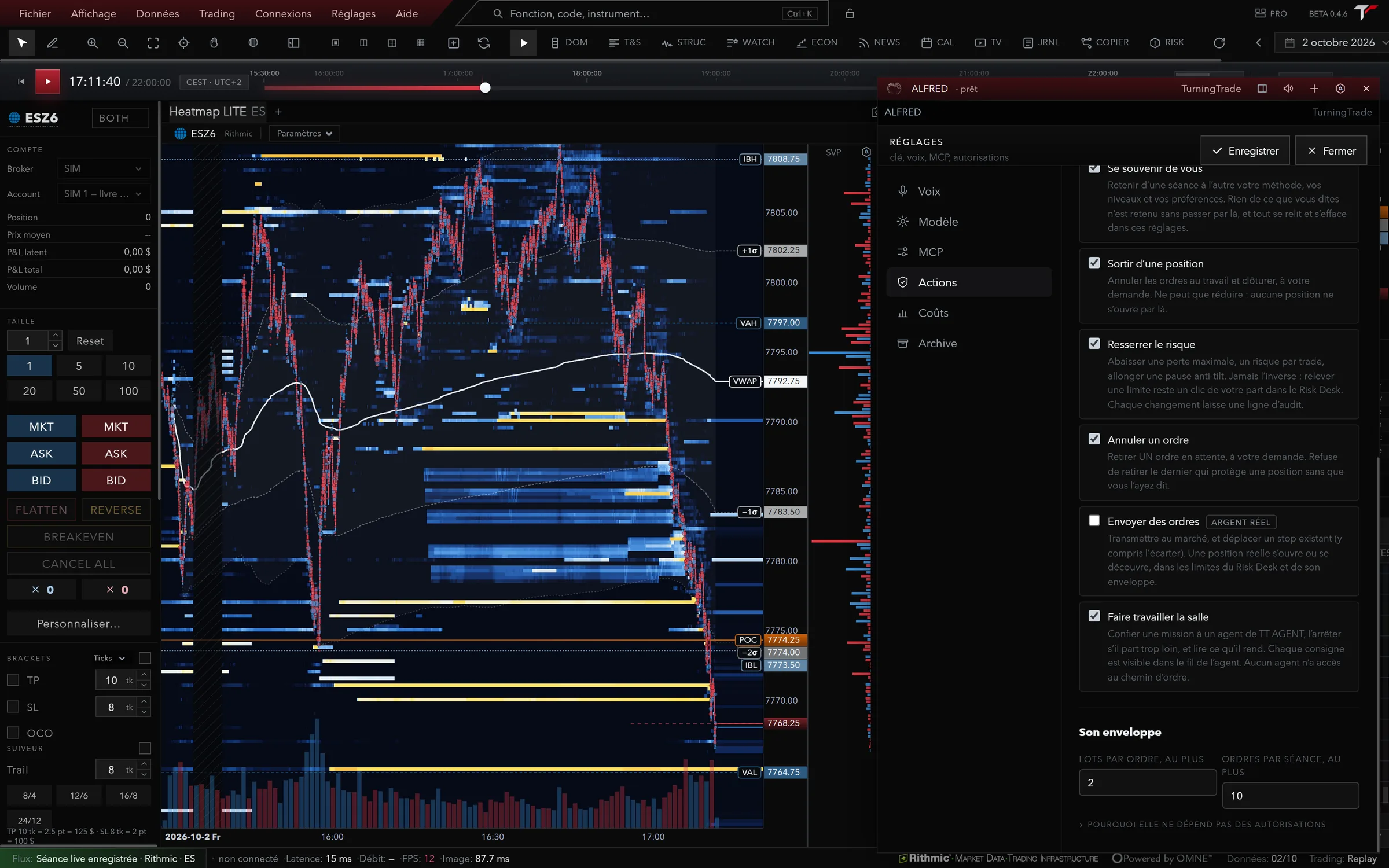
ALFRED has eleven rights, which you switch on or off one by one. By default, he arms the ticket and you click. Live order sending is the only right that’s off at install. If you switch it on, it stays bounded: 2 ES equivalents per order and 10 orders per session by default, adjustable from 1 to 50 and 1 to 200 in his settings, never from the chat, and the badge reads “real money”. Exiting a position and cancelling an order are allowed by default.
During a session, that means a sentence typed too fast at the open can’t double your size: the limit is set on a separate screen, not in the conversation.
The AI Brush: circle a zone, read its numbers
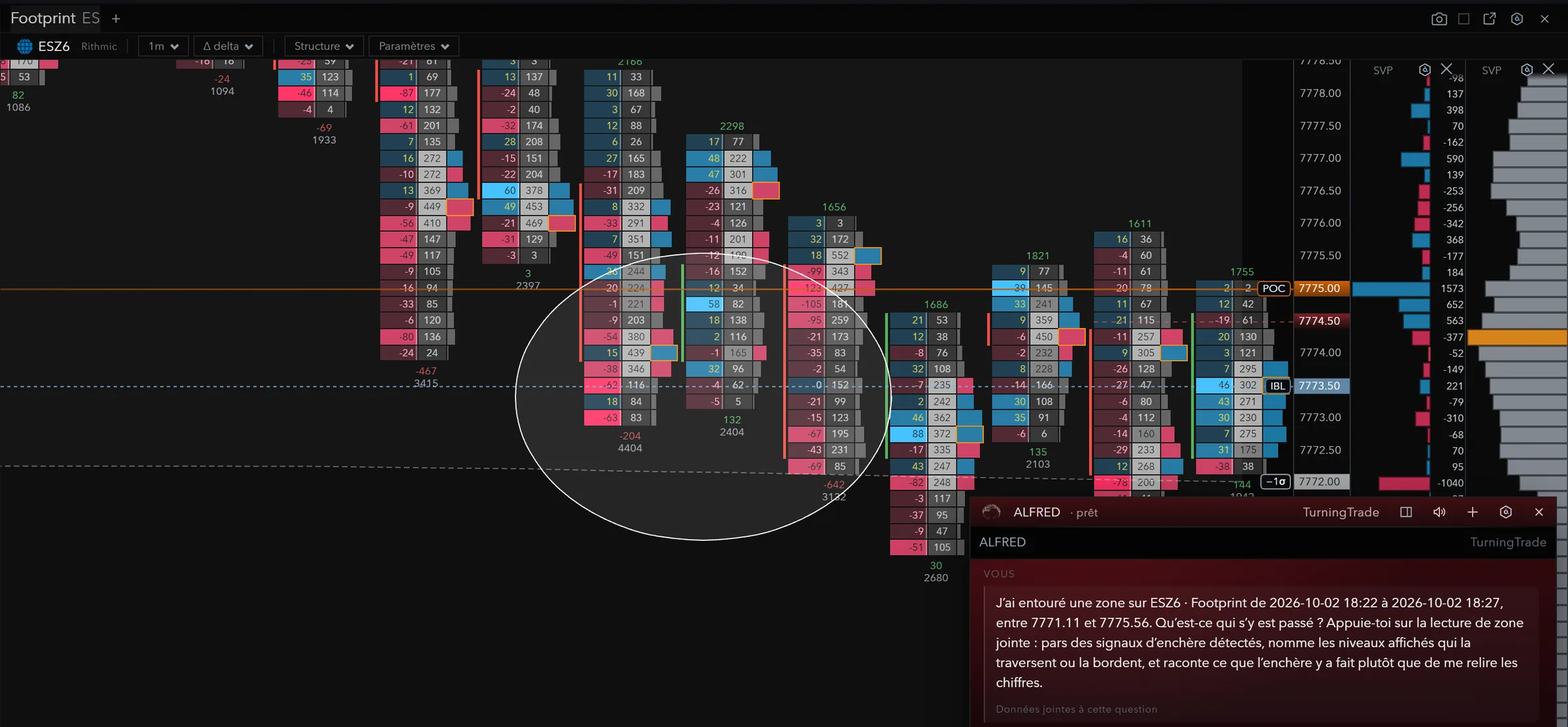
12:22 p.m. New York time on ESZ6, price spends five minutes between 7,771 and 7,775. Instead of adding up footprint cells by eye, you circle the zone with the AI Brush. ALFRED returns the zone’s volume by price, POC, value area, buy and sell delta, high, low and VWAP. The brush works on the footprint, heatmap, candles, CVD and Market Profile.
TT AGENT: a committee that gives an opinion, never an order
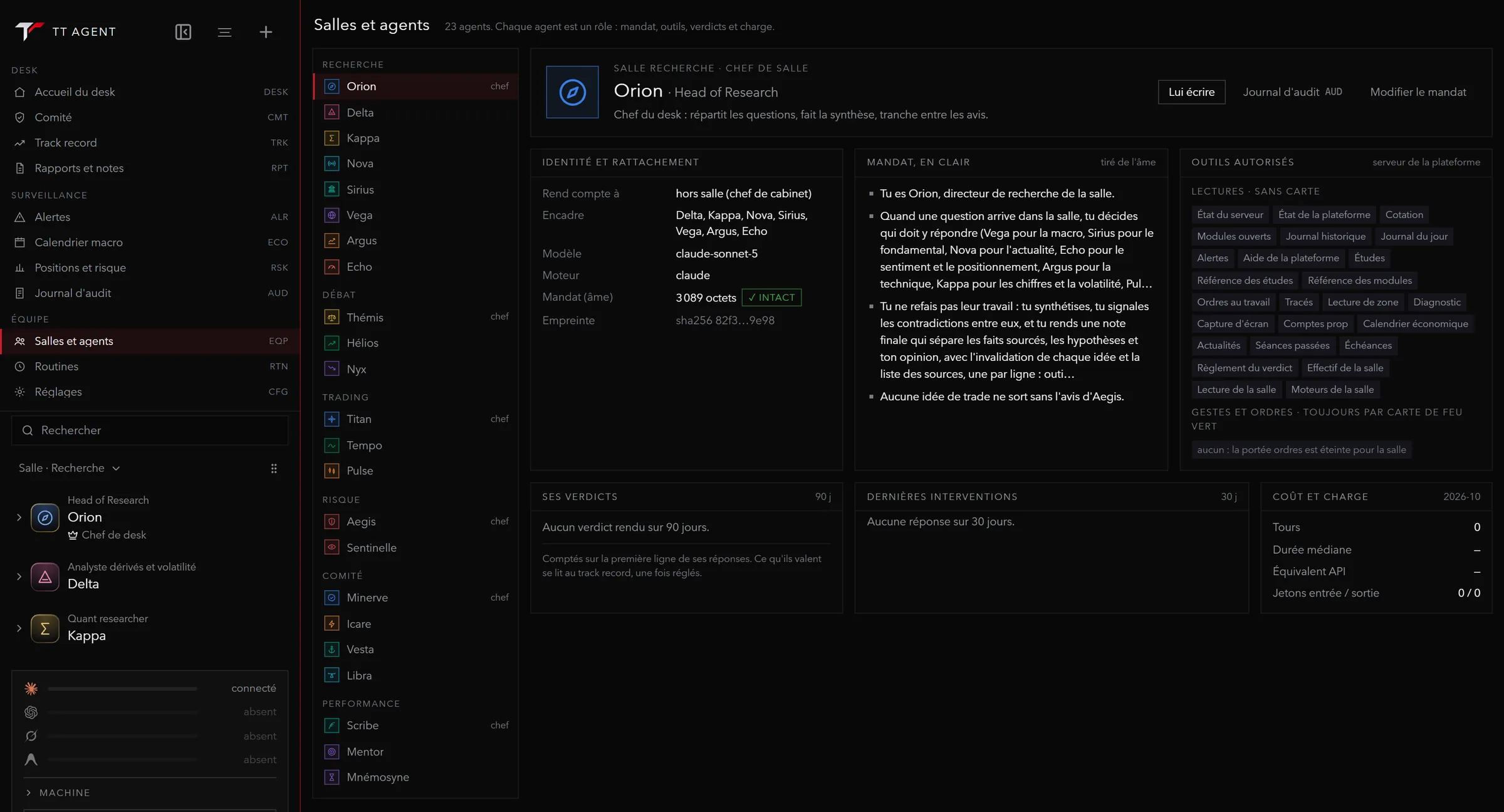
TT AGENT is a research desk of 23 AI agents across six rooms: Research, Debate, Trading, Risk, Committee, Performance. You call a committee on a contract. The analysts work, two agents debate, another prices a plan, the Risk room can veto, and the committee signs a note that opens with a five-step verdict.
Each verdict is then settled against real prices, and the track record shows it with a confidence interval, so you judge the committee on every past opinion it gave. By default the room only reads. The committee gives an opinion, never an order, and any order from an agent needs your green light. TT AGENT runs on your own AI engines (Claude Code, Codex…): a full committee puts around fifteen agents to work and uses your plan’s quota; quick mode is faster.
Claude Code, Codex or Cursor connected over MCP
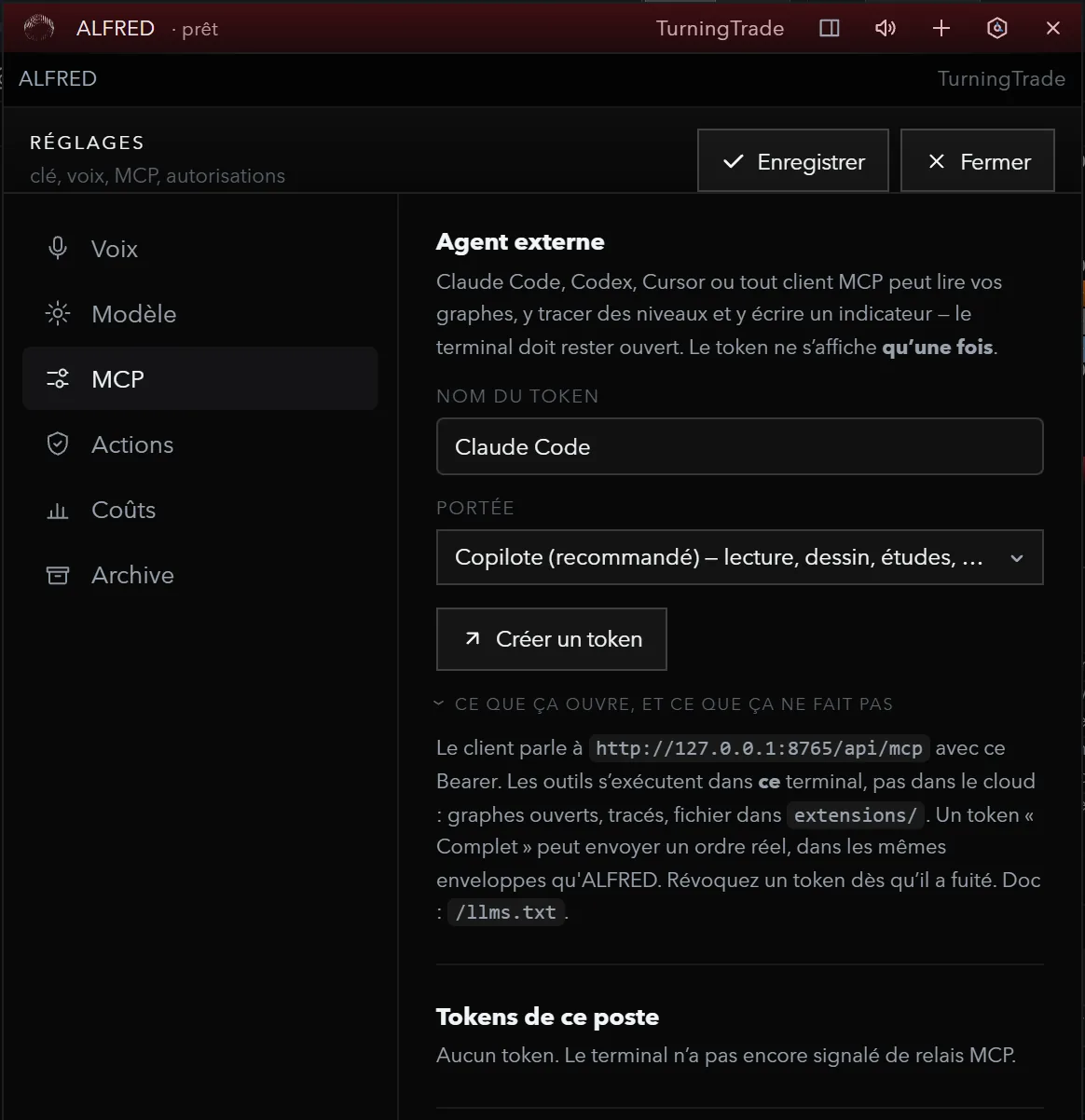
If you already work with a coding agent, it can read the platform. MCP (Model Context Protocol) is the protocol that lets an AI assistant call an application’s tools. In ALFRED you create a local token, shown only once, with one of three scopes: read-only, copilot (recommended: read, draw, studies, modules) or full (copilot plus order sending, inside the same limits as ALFRED).
A full token adds to ALFRED’s tools the connector status, the economic calendar, the news, past sessions, contract expiries and verdict settlement. Those last five answer even with the terminal closed.
TurningTrade’s four AIs, side by side
| AI | What it reads | What it does | What it doesn’t do on its own |
|---|---|---|---|
| ALFRED | Session, quotes, the book up to twenty levels, journal, alerts, working orders | Draws, tunes or writes a study, sets an alert, arms the ticket, calls the TT AGENT committee | Send a live order: the right is off at install, then bounded to 2 ES equivalents per order and 10 orders per session by default |
| AI Brush | The zone circled on the footprint, heatmap, candles, CVD or Market Profile | Returns volume by price, POC, value area, buy and sell delta, high, low and VWAP | Act on the account: it reads the zone, and what follows goes through ALFRED and his rights |
| TT AGENT | The contract you call a committee on; by default the room only reads | Debate, risk veto, a signed note with a five-step verdict, then settled against real prices | Place an order: the committee gives an opinion, and any order from an agent needs your green light |
| MCP connectors | Depends on the local token’s scope: read-only, copilot or full | Claude Code, Codex or Cursor read, draw, tune studies and modules (copilot scope) | Go beyond the limits: the full scope sends orders inside the same limits as ALFRED |
Facts from TurningTrade’s FAQ and public fact sheet. On a small screen, scroll the table sideways.
How to spot a dubious “AI” offer
Six red flags to check before you pay, with what the CFTC and the AMF say about them, read on October 19, 2026. The last column gives our own answer, so you can judge TurningTrade on the same grid.
| What the offer shows | What the regulator says | At TurningTrade |
|---|---|---|
| Huge returns generated by AI | Scammers claim AI-created algorithms can generate huge returns, sometimes tens of thousands of percent (CFTC)1 | None of the assistants is a trading robot, and none of them guarantees a result |
| A 100 percent win rate | The CFTC cites algorithms advertised with 100 percent “win” rates1 | Committee verdicts are settled against real prices and shown with their confidence interval |
| An AI that predicts the market | AI technology can’t predict the future or sudden market changes (CFTC)1 | ALFRED reads what your modules display and answers with those numbers, without recomputing them |
| Fast gains, guaranteed | Beware of unrealistic promises from trading sites guaranteeing fast gains (AMF, translated from French)2 | Software, not a broker or a trading robot: your orders go through your Rithmic account |
| A company you can’t trace | Check that the company is authorised (AMF); research its background, its key people and the age of its domain (CFTC)21 | Publisher: TURNINGTRADE LIMITED LIABILITY COMPANY, a Delaware company; a software publisher, not a broker or an investment adviser |
| Fees that stack up | Consider the impact fees, spreads and subscription costs would have on returns (CFTC)1 | Lifetime licence at 1,499 USD (1,349 EUR in the euro area), one-time payment; Rithmic account and data fees separate |
Numbers point to the sources at the bottom of the page.
One last check costs nothing: ask to see the screen. An AI that reads a book should be able to show the numbers it relies on. An offer that only shows an account balance curve tells you nothing about how it trades.
The platform around the AI
An AI only reads what the platform gives it. TurningTrade is an order flow trading platform for futures: a native Rithmic feed at the order level (MBO), 166 instruments depending on your account’s permissions, heatmap, footprint, DOM and Time & Sales, Market Profile, risk desk. Orders are routed through Rithmic only; Binance and Hyperliquid crypto perpetuals can be read, with no order routed there. It runs on Windows (0.4.9), on Apple silicon Macs (0.4.2) and on Linux as a preview (0.4.6). The order-level feed is explained in our guide to market by order (MBO) data, and the Mac build has its own page, futures trading platform for Mac.
To compare it with NinjaTrader, Sierra Chart, ATAS, Bookmap or Quantower on data feed, order flow, operating system and price, read our guide to choosing a futures trading platform.
Frequently asked questions
What is the best AI trading platform?
The one whose AI shows you what it relies on and leaves you in control. Before comparing, ask what the AI reads (the book, your orders, your journal), what it’s allowed to do without you, and how its opinions are measured. An offer that answers with a win rate hasn’t answered the question.
Can an AI trading platform trade for me?
ALFRED can send live orders if you switch that right on, inside limits set outside the conversation (2 ES equivalents per order and 10 orders per session by default). That right is off at install. TurningTrade isn’t a trading robot, and nothing guarantees a result.
Do I need an API key for ALFRED?
With an Anthropic key, billed per token, he gets all his tools and eight Claude models, Opus 5.5 by default. Through a Claude Code or Codex subscription, without a key, he answers from memory, without the platform tools.
Does TT AGENT give trading signals?
It gives an opinion: a note signed by the committee, with a five-step verdict, then settled against real prices. It places no order on its own; any order from an agent needs your green light.
How much does TurningTrade cost?
The lifetime licence costs 1,499 USD (1,349 EUR in the euro area), one-time payment, with every later version. Your Rithmic account and data fees are separate, as is the Anthropic key if you use one. Details on the Pricing page.
AI in the platform, the click on your side
Lifetime licence at 1,499 USD (1,349 EUR in the euro area), one-time payment: the platform on Windows, Mac and Linux, every later version, the 10-module order flow training and priority support. Your Rithmic account and data fees stay separate.
See pricingSources
- CFTC, Customer Advisory: AI Won’t Turn Trading Bots into Money Machines, read on October 19, 2026. Page sans date de publication affichée.
- AMF, L’AMF appelle l’attention des épargnants sur la multiplication des arnaques prenant la forme de faux articles de presse, read on October 19, 2026. Communiqué du 19 août 2026.
TurningTrade facts: release notes, pricing and FAQ published on turningtrade.com (see the Pricing page and the Help Center).